3c502d28e640681100b143a5be4038a6

THURSDAY | MARRIAGE MATTERS

THURSDAY | MARRIAGE MATTERS

One of the things we should be grateful for in our marriages is the gift of good health for our spouses.

When you have a loved one who is being tested with their health, you begin to understand that life can change in ways you never imagined. You see the pain, the uncertainty, the emotional struggles, and the helplessness that sometimes come with illness.

You also begin to appreciate the little things you may have taken for granted: your spouse waking up healthy, going about their daily activities, sharing a meal with you, engaging in conversations, and being present with you and the children.

Sometimes, we become so focused on what we wish our spouses would do differently that we forget to appreciate what Allah has already blessed us with.

Marriage is not always about grand gestures, expensive gifts, or fulfilling every expectation. Sometimes, the greatest blessing is simply having your spouse beside you, healthy enough to laugh with you, talk with you, and share the responsibilities of life.

This does not mean that couples whose spouses are battling illnesses are less fortunate in every other aspect of life. Rather, it is a reminder that every blessing deserves gratitude, and every trial calls for patience, compassion, and sincere reliance upon Allah.

Dear husband and wife, while you ask Allah to improve the areas of your marriage that need improvement, remember to thank Him for the blessings you already enjoy.

Do not wait until illness, separation, or loss reminds you of the value of what you have today.
May Allah grant our spouses good health, grant healing to those who are ill, strengthen couples facing health challenges, and make our marriages a source of comfort, mercy, and gratitude to Him. Āmīn.

Umm Sumayyah Mai

download (2)

Wednesday | Purposeful Parenting

Wednesday | Purposeful Parenting

WHEN LIFE TESTS US

When we face hardship, let them see us turn to Allah. Let them hear us make duʿā. Let them witness our patience, our gratitude, and our willingness to trust Allah even when we do not understand His decree.

This does not mean we must pretend to be strong all the time or hide every tear from our children. Rather, we should help them understand that being tested is part of life and that turning to Allah is a source of strength, comfort, and hope.

Teach them that difficulties do not necessarily mean Allah has abandoned them. Teach them that we may not always understand why certain things happen, but we can always seek Allah’s help, remain steadfast, and hope for His mercy.

Dear parents, we cannot shield our children from every trial they may encounter in life. However, we can nurture in them the faith, character, and resilience they need to navigate those trials.

Let our children learn from us that when life becomes difficult, we do not turn away from Allah; we turn back to Him.

May Allah grant us and our children steadfast hearts, strengthen our īmān during trials, and make every difficulty a means of drawing closer to Him. Āmīn.

Umm Sumayyah Mai

download (1)

The Niqab, Personal Struggles, and Our Responsibility to Allah

The Niqab, Personal Struggles, and Our Responsibility to Allah

By Allah, I have not watched the video of the sister who is currently trending on TikTok for speaking negatively about the niqab, the veil worn by Muslim women.

While your concerns may be frightening you because of the circumstances surrounding your decision to wear the niqab and your sudden removal of it, I think you should pause, reflect, and sincerely ask yourself the following questions:

1. Why did I start wearing the niqab in the first place? Was it to please Allah, to obey Him according to my understanding of the religion, or because of the influence of people around me?

2. Whose pleasure was I seeking when I wore it? Was it Allah’s pleasure or the approval of people? If it was for Allah, has the reason for wearing it changed simply because your circumstances have changed?

3. Does my current situation change my relationship with Allah? Whatever may have happened, have you considered taking your concerns to Allah in duʿā and asking Him for guidance, strength, and a way forward?

4. Am I allowing my experience to determine my understanding of the niqab? If someone mistreated you while you were wearing it, or if you faced difficulties that led you to remove it, remember that the actions of people should not be the sole basis for judging a religious practice.

5. Have I sought knowledge from people of sound Islamic knowledge? Before making a decision based on fear, public opinion, or painful experiences, have you consulted trustworthy scholars who can guide you according to the Qur’an and authentic Sunnah?

6. Am I allowing the trials and tests that come with wearing the niqab to dictate my decisions? People will talk when you wear the niqab, and many of us will also talk when you remove it, especially publicly. If your decisions are constantly shaped by the pain you are going through, when will you find the peace that comes from sincerely seeking Allah’s pleasure?

7. What do I hope to achieve by speaking publicly about my experience? Am I sharing my story to seek help, educate others, or address a genuine concern? Or am I allowing my pain to turn into words that mock or belittle something other Muslim women sincerely practise for the sake of Allah?

8. Since I removed the veil, has my life become better than before? Has the pain gone away? Have my circumstances improved? These are questions worth considering sincerely. More importantly, how can I use this experience as an opportunity to draw closer to Allah, correct any mistakes I may have made, and improve my relationship with Him?

Dear sister, your struggles deserve to be heard, and your concerns should not be dismissed. Nobody knows every detail of what you have experienced. However, pain should not become a reason to insult, ridicule, or speak carelessly about matters of religion.

Turn to Allah, seek knowledge, and ask Him to guide you to what pleases Him. You do not have to defend yourself to every person on social media, and you do not have to turn your personal experience into a public battle.

To my sisters who wear the niqab: You have made a beautiful choice, and we should encourage one another in our efforts to please Allah. This beautiful niqab can be a source of confidence and a symbol of humility. For me, wearing it has brought peace, respect, and dignity, especially when I wear it sincerely, seeking the pleasure of Allah.

I work in a hospital here in the United States while wearing this same niqab. In my personal experience, it has brought me respect, honour, and dignity. I could not be prouder of my choice. In so many ways, Allah has reassured me that He sees me and that I matter.

Wearing the niqab has never caused me any form of humiliation. Rather, in my personal experience, it has created opportunities for me to be seen, appreciated, and treated with love and care.

My dear sisters, our experiences may differ, but let us not allow the difficulties of others to make us despise what we sincerely believe is an act of worship. Let us continue to seek knowledge, renew our intentions, and ask Allah to keep us sincere and steadfast. Let us also remember that our sincerity, humility, and righteousness are not measured by the veil alone, but by our faith, intentions, and obedience to Allah.

May Allah guide our sister and all of us to what pleases Him. May He grant ease to those facing difficulties, strengthen those striving to obey Him, and protect our tongues from speaking about His religion without knowledge.

May Allah make us sincere in our worship, firm upon the truth, and beautiful in our character. Āmīn.

Umm Sumayyah Mai

Julia Hashemieh

I SHARED MY STORY WITH HER

I SHARED MY STORY WITH HER

Working with a cancer patient can be emotionally overwhelming. The pain, the uncertainty, the fear, and the agony that can come with facing death can be devastating. As the illness progresses, the physical changes can become another source of distress, both for the patient and for those caring for them.

This morning, I shared one particular trial from my own life with an individual I was caring for, and she couldn’t hold back her tears.

Though the experience wasn’t new to me. It wasn’t. But as I shared it, she was deeply moved.

Perhaps it reminded both of us of something we often forget: every one of us has something we have gone through, are going through, or may yet have to face.

No one has a life completely free of trials.

Sometimes, we look at another person and assume they have an easier life simply because we do not know what they have endured behind closed doors. So, if you are going through something today, please remember that you are not alone. Your trial may feel uniquely painful, but you are not the only one who has had to carry something heavy.

And perhaps one of the most difficult moments is when hospice becomes involved. The reality can be incredibly difficult to accept. It is hard for anyone to imagine that their health could deteriorate to the point where death may be near.

Denial, fear, sadness, anger, and uncertainty can all become part of that journey.

This is why we must continue to support our sick family members and friends. Check on them. Call them. Sit with them. Listen to them. Pray for them.

Sometimes, they do not need us to have the right words. They simply need to know that someone cares, that they are remembered, and that they do not have to walk through their difficult days feeling forgotten.

May Allah ease the suffering of every sick person, grant them shifā’, strengthen their families, and give them patience and comfort through every trial. And may He remind all of us that our health, our strength, and our lives are blessings that can change in ways we never expect.

Be kind. Check on someone today. You never truly know what another person is carrying.

Umm Sumayyah Mai

download (16)

TWO SCENARIOS

TWO SCENARIOS

In the first scenario, an individual became increasingly worried about dying and leaving behind the only child he had ever had. There was the grief, the fear, and the pain of facing an almost terminal illness.

In the second scenario, another individual became closer to Allah through listening to, reading, and learning the Qur’an. Upon hearing the recitation, I asked if he prayed. Alhamdulillah, I was happy to learn that he had always maintained his prayers.

By Allah, our circumstances can sometimes force us to become attached to what we usually neglect when we are hale, healthy, and comfortable.

What matters, however, is knowing how to return to Allah before the strike of death—before circumstances force us to confront the reality of our mortality.

The best thing we can do for ourselves is to always show up, regardless of our circumstances. Be someone who constantly and consistently calls upon his Rabb before the test of faith arrives.

Do not wait for illness to make you remember Allah.

Do not wait for fear to make you seek Him.

Do not wait for hardship to make you turn to the Qur’an.

Turn to Allah while you are healthy. Turn to Him while life is good. Turn to Him before you are tested.

May Allah keep our hearts attached to Him in times of ease and hardship, strengthen our faith before the trials come, and grant us all a beautiful ending. Āmīn.

Umm Sumayyah Mai

Fabulous

ONE BOOK AT A TIME | BOOK 4

ONE BOOK AT A TIME | BOOK 4

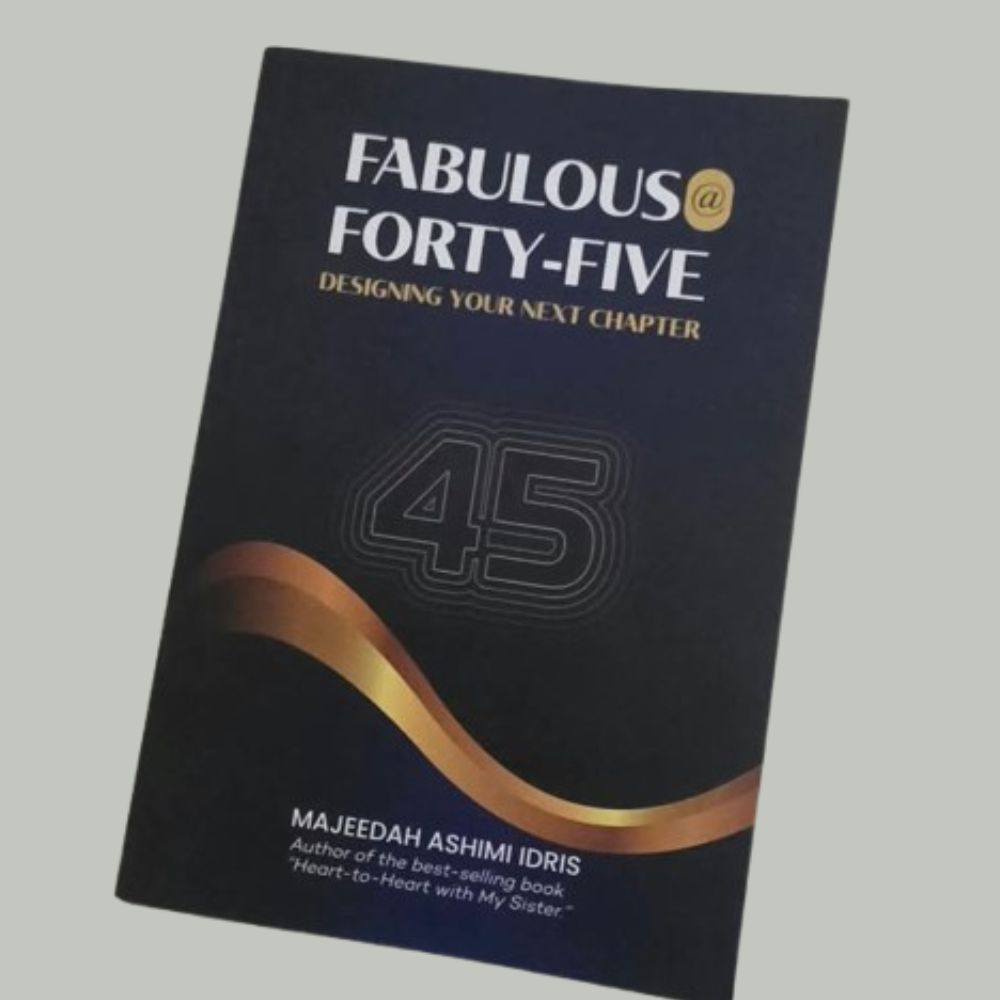
Fabulous at Forty-Five: Designing Your Next Chapter

Why did I write Fabulous at Forty-Five?

Because reaching forty-five should not be viewed simply as another birthday.

It is an opportunity to pause.
To look back at the years that have passed.
To reflect on the choices we have made.
To appreciate the lessons life has taught us.
And, perhaps most importantly, to think seriously about the chapter that lies ahead.

At forty-five, many things may have changed.
The children may be growing older.
Some dreams may have been fulfilled, while others may still be waiting.
Relationships may have evolved.
Priorities may have shifted.
And the realization that life is not endless may become much more profound.

But forty-five is not the end of the story.
It can be the beginning of a more intentional chapter.

Fabulous at Forty-Five: Designing Your Next Chapter was written to encourage reflection, purposeful living, and a deeper appreciation of the time Allah has given us.

It is about asking ourselves important questions.
What have I done with the years Allah has given me?

What still needs to be corrected?
What truly matters now?
What legacy am I building?
What kind of person do I want to become?
And if Allah grants me more years, how do I want to spend them?

Growing older should bring more than grey hairs and birthdays.

It should bring wisdom.
It should bring greater gratitude.
Greater self-awareness.
Greater responsibility.

Greater appreciation for family and relationships.
And, above all, a greater consciousness of Allah and the reality that one day we will return to Him.

There comes a time when we must stop living merely for what is temporary and begin paying greater attention to what will remain when we are no longer here.

This book is an invitation to embrace the next chapter—not with fear, but with purpose.

To release what needs to be released.
To repair what can still be repaired.
To pursue what is meaningful.
To strengthen our relationship with Allah.
And to make the years ahead more intentional than the years behind us.
Because growing older is a blessing that not everyone is given.

And if Allah has allowed us to reach another chapter, then perhaps the question is not simply,

“How old am I?”

Perhaps the better question is:
“What will I do with the years Allah has given me?”

Fabulous at Forty-Five: Designing Your Next Chapter

Price: ₦7,500

To order, call or WhatsApp:
+1 (606) 547-5331
+234 812 944 2489
+234 703 061 4992

May Allah grant every Muslim home love, mercy, justice, wisdom, and tranquility. Āmīn.

MajmolQueen Publications

Fabulous at Forty-Five: Designing Your Next Chapter

Why did I write Fabulous at Forty-Five?

Because reaching forty-five should not be viewed simply as another birthday.

It is an opportunity to pause.
To look back at the years that have passed.
To reflect on the choices we have made.
To appreciate the lessons life has taught us.
And, perhaps most importantly, to think seriously about the chapter that lies ahead.

At forty-five, many things may have changed.
The children may be growing older.
Some dreams may have been fulfilled, while others may still be waiting.
Relationships may have evolved.
Priorities may have shifted.
And the realization that life is not endless may become much more profound.

But forty-five is not the end of the story.
It can be the beginning of a more intentional chapter.

Fabulous at Forty-Five: Designing Your Next Chapter was written to encourage reflection, purposeful living, and a deeper appreciation of the time Allah has given us.

It is about asking ourselves important questions.
What have I done with the years Allah has given me?

What still needs to be corrected?
What truly matters now?
What legacy am I building?
What kind of person do I want to become?
And if Allah grants me more years, how do I want to spend them?

Growing older should bring more than grey hairs and birthdays.

It should bring wisdom.
It should bring greater gratitude.
Greater self-awareness.
Greater responsibility.

Greater appreciation for family and relationships.
And, above all, a greater consciousness of Allah and the reality that one day we will return to Him.

There comes a time when we must stop living merely for what is temporary and begin paying greater attention to what will remain when we are no longer here.

This book is an invitation to embrace the next chapter—not with fear, but with purpose.

To release what needs to be released.
To repair what can still be repaired.
To pursue what is meaningful.
To strengthen our relationship with Allah.
And to make the years ahead more intentional than the years behind us.
Because growing older is a blessing that not everyone is given.

And if Allah has allowed us to reach another chapter, then perhaps the question is not simply,

“How old am I?”

Perhaps the better question is:
“What will I do with the years Allah has given me?”

Fabulous at Forty-Five: Designing Your Next Chapter

Price: ₦7,500

To order, call or WhatsApp:
+1 (606) 547-5331
+234 812 944 2489
+234 703 061 4992

May Allah grant every Muslim home love, mercy, justice, wisdom, and tranquility. Āmīn.

MajmolQueen Publications

3c502d28e640681100b143a5be4038a6

When Peace Becomes More Important Than Winning

When Peace Becomes More Important Than Winning

I was speaking with someone this past week, and we eventually ended up talking about marriage. Apparently, we both agreed that once a marriage reaches a certain stage, the couple should learn to prioritize their happiness over conflict.

They should be more concerned with making each other happy while also thinking about their children’s success and achievements.

Marriage shouldn’t be a war zone where we no longer care about one another, humiliate one another, or intentionally hurt each other. We must learn to put past grudges and grievances in the bin and be willing to move forward, choosing to live with one another honorably.

At a certain point in marriage, peace should become more important than winning an argument, and companionship should matter more than holding on to old grievances.

Umm Sumayyah Mai

download

A TRIBUTE TO MY MOTHER

A TRIBUTE TO MY MOTHER

Dear Iya Bode,

When I think about you, I don’t simply think about a mother. I think about a woman whose life has been marked by strength, sacrifice, resilience, and love.

You became a widow while your children were still young. At a time when life could have broken you, you had to find the strength to keep going. You had seven children depending on you, and somehow, you became both the mother we needed and the strength our family depended upon.

You became the breadwinner.
You carried responsibilities that were not easy to carry.
You had your own pain, yet you still had to show up for us.
You had your own fears, yet you still had to reassure us.
You had your own needs, yet somehow, our needs still came first.

Perhaps as children, we did not understand the magnitude of what you were doing. Perhaps we saw only a mother doing what mothers do.

But now, as an adult and a mother myself, I understand much more.

It was not easy.

It takes an extraordinary woman to keep a family standing when life has taken something precious away.

And Mama, you did.
You kept going.
You sacrificed.
You endured.
You provided.
You prayed.
And you raised us.

There are sacrifices mothers make that their children may never fully understand until many years later. There are nights, worries, disappointments, and tears that children never see. There are dreams a mother quietly puts aside because her children need her more.

Today, I want you to know something:

We saw more than you may think.

And with the wisdom that comes with time, we understand even more.

Your life is written into ours.

Every one of your children carries a piece of your story. Every family you see today, every child and grandchild who calls you Mama or Grandma, is part of the legacy of the woman who refused to give up.

So, Mama, I don’t want you to look at your life and count only the years.

Look at what those years produced.
Look at the lives you touched.
Look at the children you raised.
Look at the family that came from you.
Look at the lessons that remain because you lived them before us.
Look at the strength you passed down without even realizing it.

Your life is a testimony.

A testimony of perseverance.
A testimony of sacrifice.
A testimony of a mother’s love.

And I pray that Allah allows you to enjoy the fruits of your labor while you are still with us.

May you have many more mornings where you wake up with peace in your heart. More days surrounded by people who love you. More laughter with your children and grandchildren. More moments where you can sit back, smile, and say,

“Alhamdulillah.”

Mama, if I could give you one gift, I would give you the opportunity to see yourself through the eyes of your children.

Perhaps then you would see what we see.

A woman who endured.
A woman who sacrificed.
A woman who loved.
A woman who carried more than people knew.
A woman who kept going when life gave her every reason to stop.
A woman whose strength became part of ours.
And for all of that, I say:

Alhamdulillah for you, Mama.

I ask Allah to reward you for every sacrifice that went unseen, every tear that was shed in private, every hardship you endured, every meal you provided, every prayer you made, and every act of love you gave to your children.

May Allah forgive your shortcomings, accept your good deeds, increase you in īmān, grant you comfort and good health, and surround you with genuine love.

May He bless the years ahead with peace, dignity, happiness, and beautiful memories.

And when the time comes for us all to return to Him, may Allah make your return beautiful. May He meet you with His mercy, forgive you completely, make your grave spacious and filled with light, and grant you Jannatul-Firdaus without punishment.

But Mama, not yet.

We still want you here.

There are still stories we want to hear.
There are still memories we want to make.
There are still prayers we want you to make for us.
There are still moments we want to share.
And there is still so much love we want to give you.

Your children may never be able to repay you for everything you have done.

But we can pray.

And we will.

May Allah make every good thing that comes from your children and grandchildren a ṣadaqah jāriyah for you.

May every righteous child, every act of goodness, every prayer, and every beautiful legacy you leave behind continue to speak for you long after we are gone.

Mama, you have spent much of your life giving to others. May Allah make this season of your life a season where you are surrounded, cherished, cared for, and reminded every day of just how deeply you are loved.

We love you, Mama.
We honor you.
We appreciate you.
And we thank Allah for the blessing of having you in our lives.

Alhamdulillah for you.

May Allah preserve you, honor you, forgive you, reward you, and grant you the highest place in Jannah.

Āmīn yā Rabbal-ʿĀlamīn.

With all my love,
Your daughter

Umm Sumayyah Mai

download (20)

The Promise of Allah is Always True

The Promise of Allah is Always True

When Allah promises relief, relief will come. When He promises that hardship will be followed by ease, ease will come. When He tells us that those who place their trust in Him will find Him sufficient, we can hold on to that promise even when circumstances look completely different.

Our difficulty is often not in knowing that Allah is truthful, but in remaining patient while waiting for what He has promised.

Do not let a delayed answer make you doubt Allah.

Do not let a difficult season make you think you have been forgotten. And do not allow what you see today to make you lose hope in what Allah has promised.

“Indeed, the promise of Allah is truth.”
— Qur’an 10:55

Keep trusting. Keep praying. Keep doing what is right.

Allah never breaks His promise.

Umm Sumayyah Mai

Post from Quranic Life

Tuesday | The Muslim Youth Journey

Tuesday | The Muslim Youth Journey

YOU ARE NOT TOO YOUNG TO HAVE A PURPOSE

Dear Muslim youth,

You may still be figuring out who you are, what you want to become, and where life is taking you. But never think that your age makes you insignificant.
Allah has given you time, energy, abilities, and opportunities for a reason.

Do not wait until you are older to become serious about your faith. Do not postpone your relationship with the Qur’an, your ṣalāh, your character, or your responsibility to Allah.

Your youth is not merely a season to enjoy. It is a trust.

The friends you choose, the things you watch, the words you speak, the way you treat your parents, the habits you form, and the choices you make when nobody is watching are all shaping the person you will become.

You do not have to be perfect. But you must keep striving.

Build your relationship with Allah now. Seek beneficial knowledge. Choose friends who remind you of goodness. Learn to say no when something threatens your faith. And when you fall, do not allow Shayṭān to convince you that you are too far gone to return.

You are young, but you are accountable.
You are young, but you can make a difference.
You are young, but you can be a source of goodness.

May Allah preserve our youth, strengthen their īmān, protect their hearts, guide their choices, and make them among those who live purposeful lives in obedience to Him. Āmīn.

Umm Sumayyah Mai