The-Path-to-Forgiveness-in-Couples

When Love Takes Responsibility

When Love Takes Responsibility

Love is not about finding someone who will never hurt you, because no human being is perfect and relationships can sometimes bring disappointment and pain.

But true love is about finding someone who recognizes the hurt they caused, takes responsibility for it, sincerely seeks forgiveness, and is willing to do the work necessary to heal what was broken.

It is about finding someone who does not simply say, “That is who I am,” but cares enough to change, grow, and become more careful with your heart.

Love is not the absence of mistakes. It is the presence of sincerity, accountability, repentance, forgiveness, and genuine effort to make things right.

However, love should never be used as an excuse to repeatedly tolerate abuse, betrayal, or deliberate harm. Healing can only begin when the person who caused the wound truly acknowledges it and is committed to changing.

Sometimes, love is not about finding someone who never hurts you. It is about finding someone who, after hurting you, is humble enough to say, “I was wrong,” sincere enough to change, and committed enough to help heal what they broke.

Umm Sumayyah Mai

Love is not about finding someone who will never hurt you, because no human being is perfect and relationships can sometimes bring disappointment and pain.

But true love is about finding someone who recognizes the hurt they caused, takes responsibility for it, sincerely seeks forgiveness, and is willing to do the work necessary to heal what was broken.

It is about finding someone who does not simply say, “That is who I am,” but cares enough to change, grow, and become more careful with your heart.

Love is not the absence of mistakes. It is the presence of sincerity, accountability, repentance, forgiveness, and genuine effort to make things right.

However, love should never be used as an excuse to repeatedly tolerate abuse, betrayal, or deliberate harm. Healing can only begin when the person who caused the wound truly acknowledges it and is committed to changing.

Sometimes, love is not about finding someone who never hurts you. It is about finding someone who, after hurting you, is humble enough to say, “I was wrong,” sincere enough to change, and committed enough to help heal what they broke.

Umm Sumayyah Mai

مدینة المنورة

Sunday | Seerah: The Lives of the Companions

Sunday | Seerah: The Lives of the Companions

Uthman ibn Affan (رضي الله عنه): The Man Whose Modesty Reached the Angels

There are people whose strength is loud, visible, and easily recognized. And then there are those whose strength lives quietly within their character. Uthman ibn Affan رضي الله عنه was one of them.

He was gentle, wealthy, generous, modest, soft-spoken, and deeply devoted to Allah. Yet behind his gentleness was remarkable strength—a strength that enabled him to sacrifice his wealth, endure criticism, serve the Ummah, and remain patient even during some of the most painful moments of his life.

Uthman ibn Affan رضي الله عنه teaches us something beautiful: you do not have to be loud to be strong.

The Prophet ﷺ spoke about Uthman’s modesty in a way that remains remarkable to this day. He said: “Should I not feel shy of a man whom even the angels feel shy of?” Uthman رضي الله عنه was known for his deep sense of حياء (ḥayā’)—modesty, dignity, and shyness before Allah.

In a world where people are increasingly encouraged to display everything, say everything, and expose everything, the life of Uthman رضي الله عنه reminds us that modesty is not weakness.

Modesty is strength. There is beauty in knowing what should remain private. There is dignity in guarding one’s tongue, body, relationships, and personal affairs. There is strength in refusing to seek attention simply because attention is available. Uthman رضي الله عنه reminds us that a person can possess wealth, influence, and status while remaining humble before Allah.

His Wealth Was in His Hand, Not in His Heart

Uthman رضي الله عنه was among the wealthiest Companions of the Prophet ﷺ, but his wealth did not control him. Instead, he used it to serve Allah.

When the Muslim community faced difficulty, Uthman رضي الله عنه repeatedly gave from what Allah had blessed him with. He purchased the Well of Rumah so that Muslims could benefit from its water, and during the difficult preparations for the Battle of Tabuk, he generously supported the Muslim army.

His story teaches us an important lesson about wealth: The question is not simply how much you have. The question is what your wealth does through you. Some people possess very little but are unwilling to give anything, while others possess much and hold it tightly out of fear of losing it. But Uthman رضي الله عنه understood that whatever we give sincerely for Allah is never truly lost.

Our money, possessions, talents, time, and resources are all trusts from Allah. One of the greatest blessings we can experience is to become a means through which Allah brings relief to someone else.

Perhaps you cannot finance an entire project, but can you feed someone.

You can you help a student.

You can support a widow.

You can contribute towards someone’s medical needs.

You can put a smile on someone’s face.

Never underestimate what Allah can do with the little you are willing to give sincerely.

Uthman ibn Affan رضي الله عنه became the third Rightly Guided Caliph after the passing of Umar ibn al-Khattab رضي الله عنه. One of his greatest contributions to the Muslim Ummah was his role in preserving the Qur’an in a unified written form.

As Islam spread across different regions, differences in dialect and recitation began to create concern among Muslims. Uthman رضي الله عنه took action to ensure that the Ummah remained united upon a standardized written text of the Qur’an. Because of this tremendous service, Muslims across the world continue to recite from the Qur’an, whose written preservation was safeguarded through this historic effort.

Imagine the weight of such a legacy. A person may leave behind wealth, houses, businesses, and possessions. Eventually, these things disappear or pass into other hands. But Uthman رضي الله عنه participated in a legacy that continues to benefit generations of Muslims.

This should make us ask ourselves: What will remain after we are gone?
What knowledge will we leave behind?
What child will remember our advice?
What good deed will continue to benefit others? What project will carry on after our names are forgotten?
What legacy are we building?

Gentleness Does Not Mean Weakness

Sometimes people mistake gentleness for weakness, but Uthman رضي الله عنه proves otherwise. He was gentle, but he carried enormous responsibility. He was modest, but he was a leader. He was soft-hearted, but he endured tremendous hardship. He was patient, even when patience became painful.

Not every strong person needs to shout. Not every leader needs to intimidate. Not every powerful person needs to prove their power. Sometimes, the strongest person in the room is the one who controls their anger, guards their tongue, and remains dignified when others are trying to provoke them.

His Final Days Teach Us About Patience
Great trials and unrest marked the final period of Uthman’s رضي الله عنه life. False accusations spread, opposition increased, and eventually, his home was surrounded. Yet during this painful period, Uthman رضي الله عنه showed extraordinary patience and concern for the Muslim Ummah. He did not want Muslim blood to be spilled merely to protect him.

Think about that. A man facing danger was still thinking about the consequences for others.

That is leadership. True leadership is not always asking, “Who will protect me?” Sometimes, it is asking, “How can I prevent harm from reaching others?” His patience during hardship reminds us that not every battle is won by fighting back. Sometimes, dignity lies in restraint. Sometimes, wisdom lies in refusing to allow anger to create greater destruction.

Lessons From the Life of Uthman ibn Affan رضي الله عنه
Modesty is a form of strength. You do not have to expose everything about yourself to be relevant or respected. Guarding your dignity is never something to be ashamed of.

Let your wealth serve a purpose. What you own can become a source of ongoing reward when you use it to benefit others.

Your character matters as much as your achievements.

Uthman رضي الله عنه was remembered not only for what he accomplished but also for who he was.
Gentleness and strength can live together. You can be kind without being weak. You can be soft-spoken while standing firmly upon what is right.

Build a legacy that outlives you.

The greatest investments are often the ones that continue benefiting people after we have returned to Allah. Do not allow trials to destroy your character. Anyone can behave well when life is easy. Character is truly tested when life becomes difficult.

A Final Reflection

Uthman ibn Affan رضي الله عنه lived with wealth, but his heart belonged to Allah. He possessed influence, but he remained humble. He had the ability to live comfortably, but he gave generously. He faced painful trials, but he remained patient. And his legacy continues to live centuries after his death.

Perhaps that is one of the greatest lessons from his life: Your true value is not measured by how loudly the world remembers your name. It is measured by what you did sincerely for Allah and the goodness you leave behind.

May Allah grant us hearts filled with the modesty of Uthman ibn Affan رضي الله عنه, generosity that benefits others, patience during trials, and deeds that continue to speak for us long after we have returned to Him. May Allah be pleased with Uthman ibn Affan رضي الله عنه and all the Companions of His Messenger ﷺ. Ameen.

Umm Sumayyah Mai

Uthman ibn Affan (رضي الله عنه): The Man Whose Modesty Reached the Angels

There are people whose strength is loud, visible, and easily recognized. And then there are those whose strength lives quietly within their character. Uthman ibn Affan رضي الله عنه was one of them.

He was gentle, wealthy, generous, modest, soft-spoken, and deeply devoted to Allah. Yet behind his gentleness was remarkable strength—a strength that enabled him to sacrifice his wealth, endure criticism, serve the Ummah, and remain patient even during some of the most painful moments of his life.

Uthman ibn Affan رضي الله عنه teaches us something beautiful: you do not have to be loud to be strong.

The Prophet ﷺ spoke about Uthman’s modesty in a way that remains remarkable to this day. He said: “Should I not feel shy of a man whom even the angels feel shy of?” Uthman رضي الله عنه was known for his deep sense of حياء (ḥayā’)—modesty, dignity, and shyness before Allah.

In a world where people are increasingly encouraged to display everything, say everything, and expose everything, the life of Uthman رضي الله عنه reminds us that modesty is not weakness.

Modesty is strength. There is beauty in knowing what should remain private. There is dignity in guarding one’s tongue, body, relationships, and personal affairs. There is strength in refusing to seek attention simply because attention is available. Uthman رضي الله عنه reminds us that a person can possess wealth, influence, and status while remaining humble before Allah.

His Wealth Was in His Hand, Not in His Heart

Uthman رضي الله عنه was among the wealthiest Companions of the Prophet ﷺ, but his wealth did not control him. Instead, he used it to serve Allah.

When the Muslim community faced difficulty, Uthman رضي الله عنه repeatedly gave from what Allah had blessed him with. He purchased the Well of Rumah so that Muslims could benefit from its water, and during the difficult preparations for the Battle of Tabuk, he generously supported the Muslim army.

His story teaches us an important lesson about wealth: The question is not simply how much you have. The question is what your wealth does through you. Some people possess very little but are unwilling to give anything, while others possess much and hold it tightly out of fear of losing it. But Uthman رضي الله عنه understood that whatever we give sincerely for Allah is never truly lost.

Our money, possessions, talents, time, and resources are all trusts from Allah. One of the greatest blessings we can experience is to become a means through which Allah brings relief to someone else.

Perhaps you cannot finance an entire project, but can you feed someone.

You can you help a student.

You can support a widow.

You can contribute towards someone’s medical needs.

You can put a smile on someone’s face.

Never underestimate what Allah can do with the little you are willing to give sincerely.

Uthman ibn Affan رضي الله عنه became the third Rightly Guided Caliph after the passing of Umar ibn al-Khattab رضي الله عنه. One of his greatest contributions to the Muslim Ummah was his role in preserving the Qur’an in a unified written form.

As Islam spread across different regions, differences in dialect and recitation began to create concern among Muslims. Uthman رضي الله عنه took action to ensure that the Ummah remained united upon a standardized written text of the Qur’an. Because of this tremendous service, Muslims across the world continue to recite from the Qur’an, whose written preservation was safeguarded through this historic effort.

Imagine the weight of such a legacy. A person may leave behind wealth, houses, businesses, and possessions. Eventually, these things disappear or pass into other hands. But Uthman رضي الله عنه participated in a legacy that continues to benefit generations of Muslims.

This should make us ask ourselves: What will remain after we are gone?
What knowledge will we leave behind?
What child will remember our advice?
What good deed will continue to benefit others? What project will carry on after our names are forgotten?
What legacy are we building?

Gentleness Does Not Mean Weakness

Sometimes people mistake gentleness for weakness, but Uthman رضي الله عنه proves otherwise. He was gentle, but he carried enormous responsibility. He was modest, but he was a leader. He was soft-hearted, but he endured tremendous hardship. He was patient, even when patience became painful.

Not every strong person needs to shout. Not every leader needs to intimidate. Not every powerful person needs to prove their power. Sometimes, the strongest person in the room is the one who controls their anger, guards their tongue, and remains dignified when others are trying to provoke them.

His Final Days Teach Us About Patience
Great trials and unrest marked the final period of Uthman’s رضي الله عنه life. False accusations spread, opposition increased, and eventually, his home was surrounded. Yet during this painful period, Uthman رضي الله عنه showed extraordinary patience and concern for the Muslim Ummah. He did not want Muslim blood to be spilled merely to protect him.

Think about that. A man facing danger was still thinking about the consequences for others.

That is leadership. True leadership is not always asking, “Who will protect me?” Sometimes, it is asking, “How can I prevent harm from reaching others?” His patience during hardship reminds us that not every battle is won by fighting back. Sometimes, dignity lies in restraint. Sometimes, wisdom lies in refusing to allow anger to create greater destruction.

Lessons From the Life of Uthman ibn Affan رضي الله عنه
Modesty is a form of strength. You do not have to expose everything about yourself to be relevant or respected. Guarding your dignity is never something to be ashamed of.

Let your wealth serve a purpose. What you own can become a source of ongoing reward when you use it to benefit others.

Your character matters as much as your achievements.

Uthman رضي الله عنه was remembered not only for what he accomplished but also for who he was.
Gentleness and strength can live together. You can be kind without being weak. You can be soft-spoken while standing firmly upon what is right.

Build a legacy that outlives you.

The greatest investments are often the ones that continue benefiting people after we have returned to Allah. Do not allow trials to destroy your character. Anyone can behave well when life is easy. Character is truly tested when life becomes difficult.

A Final Reflection

Uthman ibn Affan رضي الله عنه lived with wealth, but his heart belonged to Allah. He possessed influence, but he remained humble. He had the ability to live comfortably, but he gave generously. He faced painful trials, but he remained patient. And his legacy continues to live centuries after his death.

Perhaps that is one of the greatest lessons from his life: Your true value is not measured by how loudly the world remembers your name. It is measured by what you did sincerely for Allah and the goodness you leave behind.

May Allah grant us hearts filled with the modesty of Uthman ibn Affan رضي الله عنه, generosity that benefits others, patience during trials, and deeds that continue to speak for us long after we have returned to Him. May Allah be pleased with Uthman ibn Affan رضي الله عنه and all the Companions of His Messenger ﷺ. Ameen.

Umm Sumayyah Mai

download (15)

Thursday | Marital Matters

Thursday | Marital Matters

Say, “I love you,” to your spouse.

Yes, say it out loud. Say it often. Say it when you are alone, and say it even when you are around others. There is no reason to be ashamed of expressing love to the person you chose to share your life with.

Why should saying “I love you” make you uncomfortable? Why should affection between husband and wife be treated as something embarrassing?

Sometimes, we assume our spouse already knows we love them, so we stop saying it. But knowing and hearing are not always the same thing. Your spouse may know you love them, but something is comforting about hearing those words from the person whose love matters deeply to you.

Say it when things are going well. Say it after an argument when you have reconciled. Say it before you leave for work. Say it before you go to sleep. Say it when your spouse has had a difficult day.

Say it simply because you can.

And please, do not reserve words of affection for special occasions. Marriage requires everyday reassurance, not just anniversary celebrations and other special occasions.

There is no prize for being the spouse who is too emotionally reserved to express love. Your husband or wife should not have to constantly wonder whether they are loved, appreciated, desired, or valued.

A loving marriage is built not only through providing, sacrificing, and fulfilling responsibilities, but also through words, tenderness, affection, attention, and reassurance.

So, look at your spouse today and say it:

“I love you.”

And mean it.

Those three simple words may take only seconds to say, but they can bring warmth to a heart, strengthen emotional connection, and remind your spouse that beneath all the responsibilities of marriage, there is still love.

Do not be stingy with affection toward your spouse. Let them hear the love you carry in your heart.

Umm Sumayyah Mai

Say, “I love you,” to your spouse.

Yes, say it out loud. Say it often. Say it when you are alone, and say it even when you are around others. There is no reason to be ashamed of expressing love to the person you chose to share your life with.

Why should saying “I love you” make you uncomfortable? Why should affection between husband and wife be treated as something embarrassing?

Sometimes, we assume our spouse already knows we love them, so we stop saying it. But knowing and hearing are not always the same thing. Your spouse may know you love them, but something is comforting about hearing those words from the person whose love matters deeply to you.

Say it when things are going well. Say it after an argument when you have reconciled. Say it before you leave for work. Say it before you go to sleep. Say it when your spouse has had a difficult day.

Say it simply because you can.

And please, do not reserve words of affection for special occasions. Marriage requires everyday reassurance, not just anniversary celebrations and other special occasions.

There is no prize for being the spouse who is too emotionally reserved to express love. Your husband or wife should not have to constantly wonder whether they are loved, appreciated, desired, or valued.

A loving marriage is built not only through providing, sacrificing, and fulfilling responsibilities, but also through words, tenderness, affection, attention, and reassurance.

So, look at your spouse today and say it:

“I love you.”

And mean it.

Those three simple words may take only seconds to say, but they can bring warmth to a heart, strengthen emotional connection, and remind your spouse that beneath all the responsibilities of marriage, there is still love.

Do not be stingy with affection toward your spouse. Let them hear the love you carry in your heart.

Umm Sumayyah Mai

download (2)

✍🏽 POST 4 | WHY I WRITE

✍🏽 POST 4 | WHY I WRITE

I Don’t Write Merely to Publish Books. I Write Because I Have Something to Leave Behind.

Writing, for me, has never been simply about putting words on paper or producing another book to add to a collection.

I write because sometimes, a lesson needs to be preserved. Sometimes, a reminder needs to be given. Sometimes, someone needs to hear the very words they have been searching for but could not find. And sometimes, experiences teach us things that are too valuable to keep to ourselves.

I write to teach what I have learned.

I write to remind myself and others of truths we may know but sometimes forget.

I write to encourage the woman who is quietly struggling, the parent who is wondering whether they are doing enough, the young person trying to navigate life, and the couple learning how to build and preserve a meaningful marriage.

I write because words can reach places that physical presence cannot.

There are people I may never meet, conversations I may never have, and homes I may never enter. Yet, through a book, a message can travel beyond me and sit quietly in someone’s hands at exactly the moment they need it.

That thought humbles me.

Many of the things I write about are drawn from years of observation, conversations, experiences, lessons, questions, mistakes, growth, and sincere reflection. Some things are written because they needed to be said. Others are written because I wish someone had told me sooner.

And perhaps that is one of the beautiful things about writing: you can turn lessons from your journey into light for someone else’s.

My books, therefore, are not merely products to me.

They carry reminders.

They carry lessons.

They carry advice.

They carry prayers.

They carry pieces of my heart.

And above all, they carry a hope that something within those pages will benefit someone long after they have forgotten who wrote them.

I often think about what we leave behind.

Our possessions will eventually belong to someone else. Our positions will be filled by others. Our names may one day become distant memories.

But beneficial knowledge can continue to travel.

A lesson you taught may be repeated. A reminder you shared may change a life. A child may grow differently because of something a parent learned.

A marriage may be strengthened because someone read the right words at the right time. A struggling person may find courage because a message reminded them not to give up.

That is the kind of legacy I desire.

Not simply to say, “I wrote books.”

But to be able to say, “I tried to leave something beneficial behind.”

If even one page from any of my books makes someone reflect, change, heal, become more intentional, strengthen their relationship with Allah, become a better parent, spouse, child, or human being, then the writing was worth it.

Because ultimately, I don’t want my books to merely sit on bookshelves.

I want them to live in hearts, influence lives, and continue to benefit people beyond my presence.

That is why I write.

And perhaps, that is why I will continue to write for as long as Allah gives me the ability.

May Allah make every word I write beneficial, sincere, and a source of reward that continues long after I am gone. Āmīn.

MajmolQueen Publications

I Don’t Write Merely to Publish Books. I Write Because I Have Something to Leave Behind.

Writing, for me, has never been simply about putting words on paper or producing another book to add to a collection.

I write because sometimes, a lesson needs to be preserved. Sometimes, a reminder needs to be given. Sometimes, someone needs to hear the very words they have been searching for but could not find. And sometimes, experiences teach us things that are too valuable to keep to ourselves.

I write to teach what I have learned.

I write to remind myself and others of truths we may know but sometimes forget.

I write to encourage the woman who is quietly struggling, the parent who is wondering whether they are doing enough, the young person trying to navigate life, and the couple learning how to build and preserve a meaningful marriage.

I write because words can reach places that physical presence cannot.

There are people I may never meet, conversations I may never have, and homes I may never enter. Yet, through a book, a message can travel beyond me and sit quietly in someone’s hands at exactly the moment they need it.

That thought humbles me.

Many of the things I write about are drawn from years of observation, conversations, experiences, lessons, questions, mistakes, growth, and sincere reflection. Some things are written because they needed to be said. Others are written because I wish someone had told me sooner.

And perhaps that is one of the beautiful things about writing: you can turn lessons from your journey into light for someone else’s.

My books, therefore, are not merely products to me.

They carry reminders.

They carry lessons.

They carry advice.

They carry prayers.

They carry pieces of my heart.

And above all, they carry a hope that something within those pages will benefit someone long after they have forgotten who wrote them.

I often think about what we leave behind.

Our possessions will eventually belong to someone else. Our positions will be filled by others. Our names may one day become distant memories.

But beneficial knowledge can continue to travel.

A lesson you taught may be repeated. A reminder you shared may change a life. A child may grow differently because of something a parent learned.

A marriage may be strengthened because someone read the right words at the right time. A struggling person may find courage because a message reminded them not to give up.

That is the kind of legacy I desire.

Not simply to say, “I wrote books.”

But to be able to say, “I tried to leave something beneficial behind.”

If even one page from any of my books makes someone reflect, change, heal, become more intentional, strengthen their relationship with Allah, become a better parent, spouse, child, or human being, then the writing was worth it.

Because ultimately, I don’t want my books to merely sit on bookshelves.

I want them to live in hearts, influence lives, and continue to benefit people beyond my presence.

That is why I write.

And perhaps, that is why I will continue to write for as long as Allah gives me the ability.

May Allah make every word I write beneficial, sincere, and a source of reward that continues long after I am gone. Āmīn.

MajmolQueen Publications

[QUIZ] Profil apprentissage Écriture & Kinesthésique _ Coran De Mon Cœur

Wednesday | Purposeful Parenting

Wednesday | Purposeful Parenting

The Children We Raise Today Will Shape the Ummah Tomorrow

Parenting is more than providing food, clothing, education, and a comfortable home. It is the responsibility of nurturing a soul and helping a child grow into a person who knows his or her purpose, understands right from wrong, and remains connected to Allah throughout life’s journey.

Every day, our children are learning from us—not only from what we tell them, but from what they see us do. They watch how we speak when we are angry, how we treat their father or mother, how we respond when life becomes difficult, and whether we turn to Allah when we are worried. They notice whether we apologize when we are wrong and learn what we truly value by watching how we live.

That is why purposeful parenting requires intentionality. We should not only ask, “What do I want my child to become?” We should also ask, “Who am I helping my child become?” Do I want a child who merely succeeds academically, or one who knows his purpose? Do I want a child who knows how to earn money, or one who understands halal and haram? Do I want a confident child, or a child whose confidence is rooted in knowing that Allah created and honored him?

Our ultimate goal should not simply be to raise children who can survive in this world. We should strive to raise children who can navigate this world without losing their way to the Hereafter. Allah says: “O you who believe, protect yourselves and your families from a Fire whose fuel is people and stones…” (Qur’an 66:6).

This is why purposeful parenting begins long before adulthood. We teach our children ṣalāh before they desperately need it. We teach them honesty before dishonesty becomes convenient, responsibility before the world demands it from them, and modesty, kindness, courage, forgiveness, and self-control before life puts these qualities to the test. We teach them to apologize when they are wrong, to keep their promises, to stand for what is right, and above all, to know, love, worship, and depend upon Allah.

And we must remember that our children do not need perfect parents. They need parents who are willing to grow, learn, repent, apologize, and keep trying. Sometimes, one of the greatest lessons we can teach our children is not that we never make mistakes, but that when we do, we take responsibility, seek forgiveness, make amends, and return to Allah.

May Allah make us parents who raise children who are conscious of ṣalāḥ in this world, a benefit to the Ummah, and a continuing source of reward for us after we return to Allah. Āmīn.

Umm Sumayyah Mai
The Children We Raise Today Will Shape the Ummah Tomorrow

Parenting is more than providing food, clothing, education, and a comfortable home. It is the responsibility of nurturing a soul and helping a child grow into a person who knows his or her purpose, understands right from wrong, and remains connected to Allah throughout life’s journey.

Every day, our children are learning from us—not only from what we tell them, but from what they see us do. They watch how we speak when we are angry, how we treat their father or mother, how we respond when life becomes difficult, and whether we turn to Allah when we are worried. They notice whether we apologize when we are wrong and learn what we truly value by watching how we live.

That is why purposeful parenting requires intentionality. We should not only ask, “What do I want my child to become?” We should also ask, “Who am I helping my child become?” Do I want a child who merely succeeds academically, or one who knows his purpose? Do I want a child who knows how to earn money, or one who understands halal and haram? Do I want a confident child, or a child whose confidence is rooted in knowing that Allah created and honored him?

Our ultimate goal should not simply be to raise children who can survive in this world. We should strive to raise children who can navigate this world without losing their way to the Hereafter. Allah says: “O you who believe, protect yourselves and your families from a Fire whose fuel is people and stones…” (Qur’an 66:6).

This is why purposeful parenting begins long before adulthood. We teach our children ṣalāh before they desperately need it. We teach them honesty before dishonesty becomes convenient, responsibility before the world demands it from them, and modesty, kindness, courage, forgiveness, and self-control before life puts these qualities to the test. We teach them to apologize when they are wrong, to keep their promises, to stand for what is right, and above all, to know, love, worship, and depend upon Allah.

And we must remember that our children do not need perfect parents. They need parents who are willing to grow, learn, repent, apologize, and keep trying. Sometimes, one of the greatest lessons we can teach our children is not that we never make mistakes, but that when we do, we take responsibility, seek forgiveness, make amends, and return to Allah.

May Allah make us parents who raise children who are conscious of ṣalāḥ in this world, a benefit to the Ummah, and a continuing source of reward for us after we return to Allah. Āmīn.

Umm Sumayyah Mai
download (1)

Tuesday | The Muslim Youth Journey

Tuesday | The Muslim Youth Journey

When Your Parents Correct You, Don’t Mistake It for Rejection

One of the most difficult things for a young person is being corrected by their parents—especially when they feel they are old enough to make their own decisions.

Sometimes, a parent’s words may come across as harsh. Sometimes, you may feel they do not understand your generation, your struggles, or the world you are growing up in.

But before you conclude, “My parents don’t understand me,” or “They just don’t want me to be happy,” pause.

Correction is not always rejection. Guidance is not abandonment. And disagreement does not mean a lack of love.

Your parents may not always express themselves perfectly, but many of their concerns come from experiences you have not yet lived.

Allah says:
“And We have enjoined upon man goodness to his parents.” — Qur’an 29:8

Being a respectful child does not mean you can never disagree with your parents. It means you learn how to disagree without becoming disrespectful.

You can say, “I understand your concern, but may I explain how I see it?”

You can ask questions instead of raising your voice.

You can express your feelings without insulting them.

You can seek clarification instead of assuming the worst.

And when they correct you, listen before you defend yourself.

Perhaps they are wrong about something. Perhaps you are right. But even then, your character matters.

Remember: How you respond to correction says a lot about the person you are becoming.

And parents, too, have a responsibility. Correction should not become humiliation, constant criticism, or a refusal to listen. Children need guidance and a safe space to communicate.

To every Muslim young person:

Do not allow a temporary disagreement with your parents to create a permanent distance between you.

Talk to them. Listen to them. Respect them.

And when you feel misunderstood, make duʿāʾ before making assumptions.

May Allah place love, wisdom, patience, and understanding between parents and their children. Ameen. 🤍

Tuesday | The Muslim Youth Journey: Growing in faith. Growing in wisdom. Growing into the person Allah wants you to become.

Umm Sumayyah Mai

When Your Parents Correct You, Don’t Mistake It for Rejection

One of the most difficult things for a young person is being corrected by their parents—especially when they feel they are old enough to make their own decisions.

Sometimes, a parent’s words may come across as harsh. Sometimes, you may feel they do not understand your generation, your struggles, or the world you are growing up in.

But before you conclude, “My parents don’t understand me,” or “They just don’t want me to be happy,” pause.

Correction is not always rejection. Guidance is not abandonment. And disagreement does not mean a lack of love.

Your parents may not always express themselves perfectly, but many of their concerns come from experiences you have not yet lived.

Allah says:
“And We have enjoined upon man goodness to his parents.” — Qur’an 29:8

Being a respectful child does not mean you can never disagree with your parents. It means you learn how to disagree without becoming disrespectful.

You can say, “I understand your concern, but may I explain how I see it?”

You can ask questions instead of raising your voice.

You can express your feelings without insulting them.

You can seek clarification instead of assuming the worst.

And when they correct you, listen before you defend yourself.

Perhaps they are wrong about something. Perhaps you are right. But even then, your character matters.

Remember: How you respond to correction says a lot about the person you are becoming.

And parents, too, have a responsibility. Correction should not become humiliation, constant criticism, or a refusal to listen. Children need guidance and a safe space to communicate.

To every Muslim young person:

Do not allow a temporary disagreement with your parents to create a permanent distance between you.

Talk to them. Listen to them. Respect them.

And when you feel misunderstood, make duʿāʾ before making assumptions.

May Allah place love, wisdom, patience, and understanding between parents and their children. Ameen. 🤍

Tuesday | The Muslim Youth Journey: Growing in faith. Growing in wisdom. Growing into the person Allah wants you to become.

Umm Sumayyah Mai

Majmol

POST 3 | MEET THE BOOKS

POST 3 | MEET THE BOOKS

Six books. Six journeys. Countless lessons.

Behind every book is a message.
Behind every message is a purpose.

Each of these books was written with a particular reader, struggle, question, or season of life in mind. Some were born from years of observation and experience, while others came from a deep desire to offer guidance, encouragement, and sincere reminders that may reach someone exactly when they need them.

Today, I am honoured to introduce you to my six published books—each one carrying a message close to my heart.

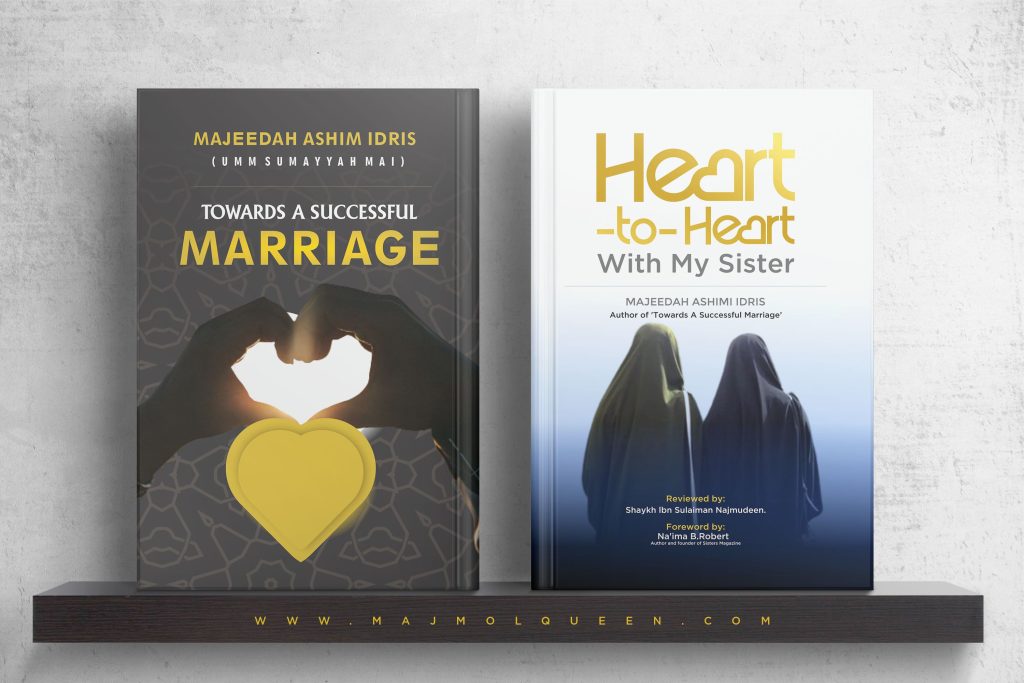
📕 1. Towards a Successful Marriage:
A book designed to help you choose carefully before saying “I do,” while offering practical and faith-based guidance for building a successful and meaningful marriage.

📗 2. Beloved Darling: A Mother’s Heartfelt Guidance:
A mother’s heartfelt collection of advice, wisdom, and life lessons, written to guide children as they navigate childhood, adolescence, and adulthood.

📘 3. Empowered Beyond 18: A Parental Guide for Lasting Impact:
A practical guide for parents who desire to raise successful, responsible, and well-rounded children, while recognizing that parenting and parental influence extend beyond the age of eighteen.

📙 4. Fabulous at Forty-Five: Designing Your Next Chapter:
A reminder to embrace a new season of life with purpose while remembering the ultimate journey ahead—the reality of death, the grave, and our inevitable meeting with Allah. It encourages us to reflect, prepare, and make the most of the time Allah has given us.

📔 5. Thriving Together: Strategies for Overcoming Polygyny Challenges
A practical and thoughtful guide on navigating the realities and challenges of polygyny, with reminders and strategies for making polygyny thrive through understanding, fairness, communication, patience, and intentionality.

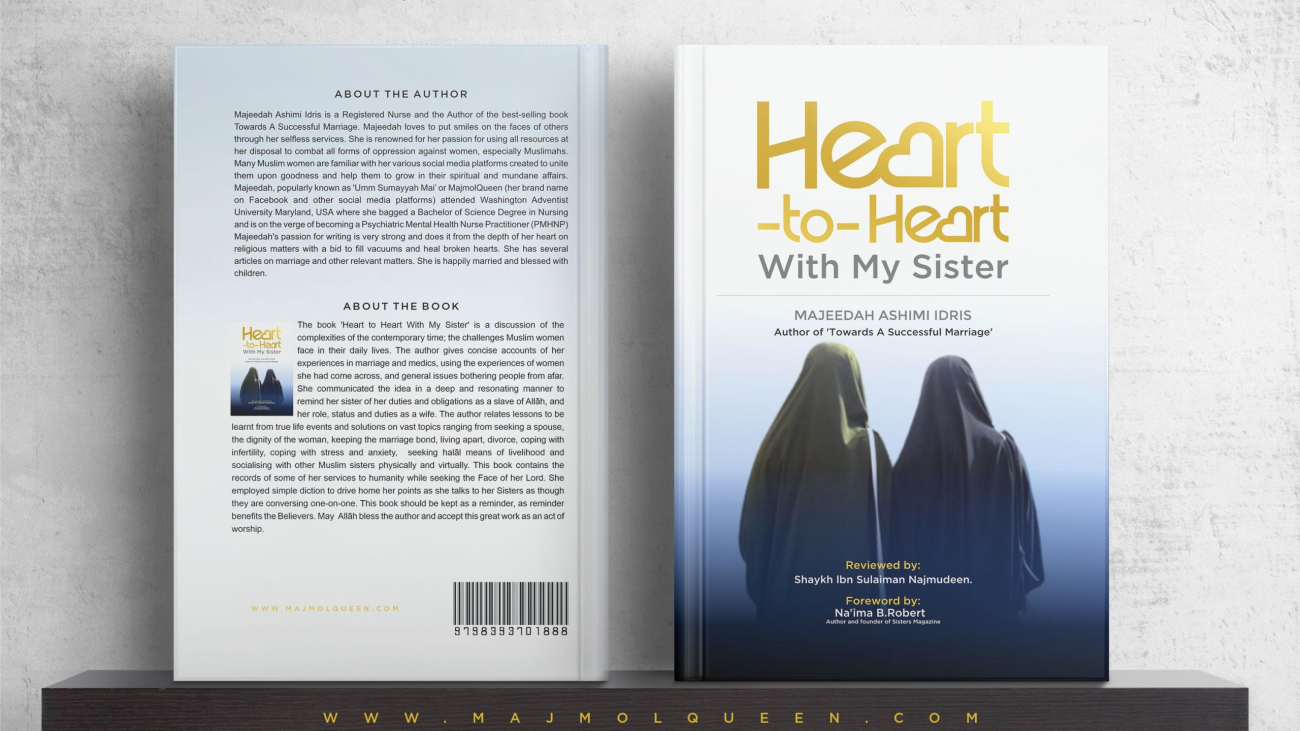
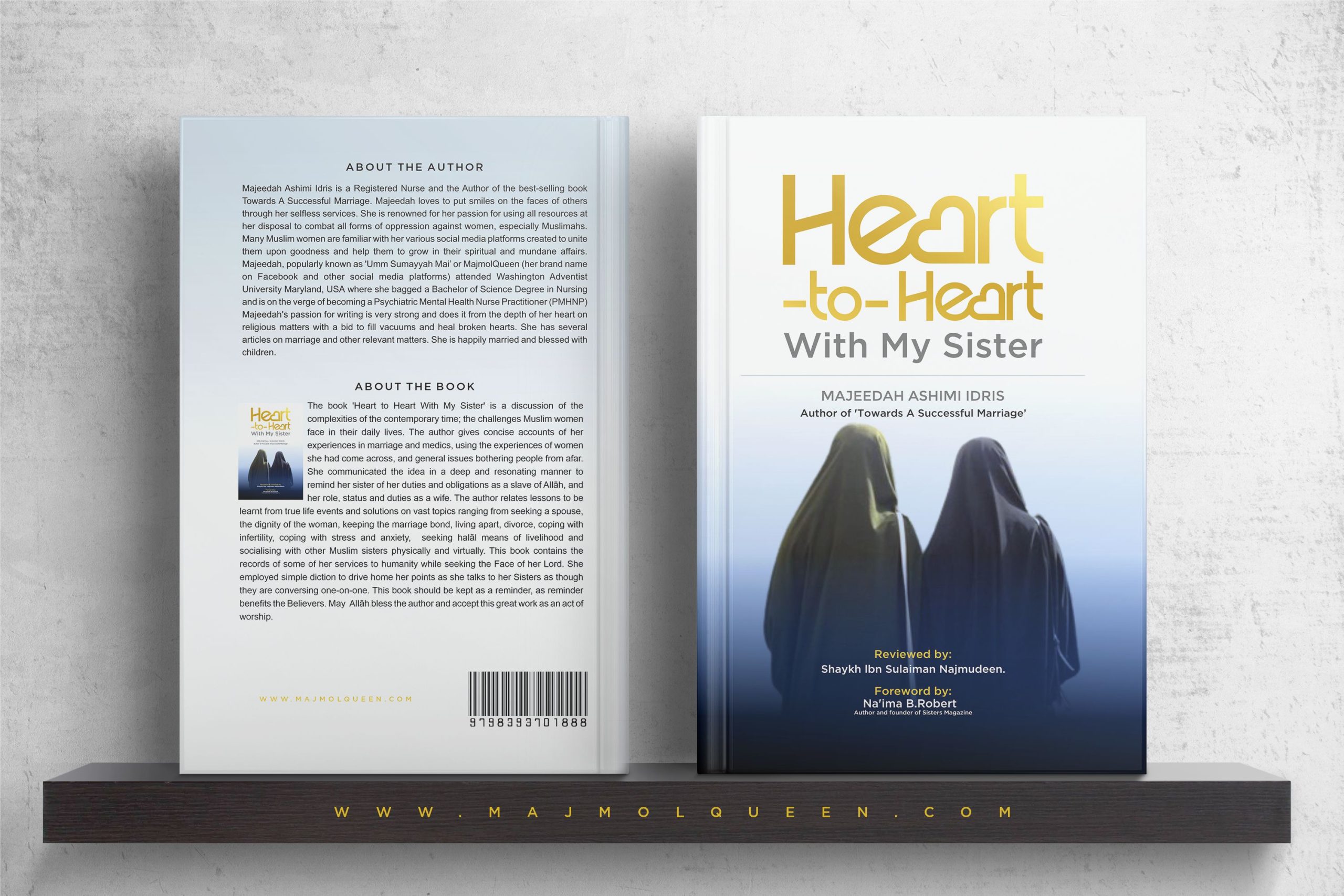
📒 6. Heart-to-Heart With My Sister:
A sincere conversation filled with heartfelt advice and reflections on matters such as marriage, business, forgiveness, relationships, and life—offering the kind of honest and sincere counsel one sister would give another.

Six books. Six different journeys. One heart behind them all.

To write.
To guide.
To encourage.
To remind.

And, by Allah’s permission, to leave behind words that continue to benefit others.

This is my body of published work so far, and I am grateful to Allah for every opportunity to write, share, and serve through words.

Welcome to my bookshelf.
Welcome to my world of words.

— Majeedah Ashimi Idris (MajmolQueen)

Six books. Six journeys. Countless lessons.

Behind every book is a message.
Behind every message is a purpose.

Each of these books was written with a particular reader, struggle, question, or season of life in mind. Some were born from years of observation and experience, while others came from a deep desire to offer guidance, encouragement, and sincere reminders that may reach someone exactly when they need them.

Today, I am honoured to introduce you to my six published books—each one carrying a message close to my heart.

📕 1. Towards a Successful Marriage:
A book designed to help you choose carefully before saying “I do,” while offering practical and faith-based guidance for building a successful and meaningful marriage.

📗 2. Beloved Darling: A Mother’s Heartfelt Guidance:
A mother’s heartfelt collection of advice, wisdom, and life lessons, written to guide children as they navigate childhood, adolescence, and adulthood.

📘 3. Empowered Beyond 18: A Parental Guide for Lasting Impact:
A practical guide for parents who desire to raise successful, responsible, and well-rounded children, while recognizing that parenting and parental influence extend beyond the age of eighteen.

📙 4. Fabulous at Forty-Five: Designing Your Next Chapter:
A reminder to embrace a new season of life with purpose while remembering the ultimate journey ahead—the reality of death, the grave, and our inevitable meeting with Allah. It encourages us to reflect, prepare, and make the most of the time Allah has given us.

📔 5. Thriving Together: Strategies for Overcoming Polygyny Challenges
A practical and thoughtful guide on navigating the realities and challenges of polygyny, with reminders and strategies for making polygyny thrive through understanding, fairness, communication, patience, and intentionality.

📒 6. Heart-to-Heart With My Sister:
A sincere conversation filled with heartfelt advice and reflections on matters such as marriage, business, forgiveness, relationships, and life—offering the kind of honest and sincere counsel one sister would give another.

Six books. Six different journeys. One heart behind them all.

To write.
To guide.
To encourage.
To remind.

And, by Allah’s permission, to leave behind words that continue to benefit others.

This is my body of published work so far, and I am grateful to Allah for every opportunity to write, share, and serve through words.

Welcome to my bookshelf.
Welcome to my world of words.

— Majeedah Ashimi Idris (MajmolQueen)

Majeedah Ashimi

POST 2 | MEET THE AUTHOR

POST 2 | MEET THE AUTHOR

Behind Every Book Is a Heart That Had Something to Say…

Behind every book is a story.

Sometimes, it is a story born from years of observation. Sometimes, from conversations that lingered long after they ended. Sometimes, from questions people were afraid to ask. And sometimes, from a deep desire to share a reminder that someone, somewhere, may desperately need.

Behind these books is MajmolQueen — Majeedah Ashimi Idris, also known as Umm Sumayyah Mai:a writer, a mother, a nurse, a lifelong learner, and, above all, a servant of Allah who believes that words carry responsibility.

I write because I believe a well-chosen word can teach, comfort, challenge, redirect, and sometimes even change the course of a person’s life.

My writings are inspired by faith, family, marriage, motherhood, relationships, personal growth, and the realities of navigating life while striving to remain anchored to Allah.

Some of my books were born from things I have observed. Some from lessons I have learned. Some from questions I have been asked. And some simply from the feeling that this needs to be said.

I do not write because I believe I have all the answers. I write because I am still learning too.
I write to share what I have learned, what I continue to discover, and the reminders I wish more of us would hear — especially in a world where we are constantly surrounded by noise, yet often in need of sincere guidance.

I hope that when you pick up one of my books, you will find more than words on pages. I hope you find a reminder when you need one, a perspective you had not considered, a question worth reflecting upon, a lesson worth carrying, or perhaps words that reach you at exactly the right moment.

And perhaps that is why I continue to write.
Because we may never know which sentence Allah will allow to become beneficial to someone.
Welcome to my world of books and writings.

Welcome to MajmolQueen Publications.

May Allah place sincerity in every word, benefit in every page, and barakah in every effort made for His sake.

https://www.facebook.com/share/p/1JbgTfKFYr/

— MajmolQueen Publications

Behind Every Book Is a Heart That Had Something to Say…

Behind every book is a story.

Sometimes, it is a story born from years of observation. Sometimes, from conversations that lingered long after they ended. Sometimes, from questions people were afraid to ask. And sometimes, from a deep desire to share a reminder that someone, somewhere, may desperately need.

Behind these books is MajmolQueen — Majeedah Ashimi Idris, also known as Umm Sumayyah Mai:a writer, a mother, a nurse, a lifelong learner, and, above all, a servant of Allah who believes that words carry responsibility.

I write because I believe a well-chosen word can teach, comfort, challenge, redirect, and sometimes even change the course of a person’s life.

My writings are inspired by faith, family, marriage, motherhood, relationships, personal growth, and the realities of navigating life while striving to remain anchored to Allah.

Some of my books were born from things I have observed. Some from lessons I have learned. Some from questions I have been asked. And some simply from the feeling that this needs to be said.

I do not write because I believe I have all the answers. I write because I am still learning too.
I write to share what I have learned, what I continue to discover, and the reminders I wish more of us would hear — especially in a world where we are constantly surrounded by noise, yet often in need of sincere guidance.

I hope that when you pick up one of my books, you will find more than words on pages. I hope you find a reminder when you need one, a perspective you had not considered, a question worth reflecting upon, a lesson worth carrying, or perhaps words that reach you at exactly the right moment.

And perhaps that is why I continue to write.
Because we may never know which sentence Allah will allow to become beneficial to someone.
Welcome to my world of books and writings.

Welcome to MajmolQueen Publications.

May Allah place sincerity in every word, benefit in every page, and barakah in every effort made for His sake.

https://www.facebook.com/share/p/1JbgTfKFYr/

— MajmolQueen Publications

[QUIZ] Profil apprentissage Écriture & Kinesthésique _ Coran De Mon Cœur

Wednesday | Purposeful Parenting

Wednesday | Purposeful Parenting

Raise children who know why, not merely children who know what. Purposeful parenting is not simply teaching our children what to do; it is helping them understand why they do it.

Teach your child to pray, but also teach them who they are praying to. Teach them honesty, but explain that Allah sees what people cannot see. Teach them kindness, but remind them that every act of goodness is known to Allah. Teach them responsibility, but let them understand that they will one day be accountable for what Allah entrusted to them.

Our goal should not be to raise children who behave well only when we are watching. We should strive to raise children whose hearts remain connected to Allah even when nobody is watching. Because one day, our voices will no longer be beside them. Our reminders will become memories. Our hands will no longer guide them.
And when that day comes, what will sustain them is not merely what we told them to do, but the faith we helped plant within their hearts.

Parent intentionally.
Teach patiently.
Correct wisely.
Love deeply.
And above all, raise them for Allah.

Umm Sumayyah Mai

Raise children who know why, not merely children who know what. Purposeful parenting is not simply teaching our children what to do; it is helping them understand why they do it.

Teach your child to pray, but also teach them who they are praying to. Teach them honesty, but explain that Allah sees what people cannot see. Teach them kindness, but remind them that every act of goodness is known to Allah. Teach them responsibility, but let them understand that they will one day be accountable for what Allah entrusted to them.

Our goal should not be to raise children who behave well only when we are watching. We should strive to raise children whose hearts remain connected to Allah even when nobody is watching. Because one day, our voices will no longer be beside them. Our reminders will become memories. Our hands will no longer guide them.
And when that day comes, what will sustain them is not merely what we told them to do, but the faith we helped plant within their hearts.

Parent intentionally.
Teach patiently.
Correct wisely.
Love deeply.
And above all, raise them for Allah.

Umm Sumayyah Mai

download (18)

Treat Your Dreams With Caution

Treat Your Dreams With Caution

Not every dream deserves your fear.

One of the things that can quietly weaken a person’s īmān is becoming so frightened by a dream that it begins to affect one’s tawakkul in Allah. A person sees something disturbing in their sleep and wakes up anxious, convinced that it must be a warning of an approaching calamity. They spend days worrying, anticipating disaster, and interpreting every little event through the lens of that dream.

But the believer must remember: a dream does not have power over your destiny. Allah does.

The Prophet ﷺ taught us that dreams are of different types. Some are good dreams from Allah, some are disturbing dreams from Shayṭān, and some are simply the result of what occupies a person’s mind. So when you see something frightening, do not allow Shayṭān to turn a dream into a source of fear and weakness.

The Prophet ﷺ instructed that when a person sees a dream they dislike, they should seek refuge in Allah from its evil and from Shayṭān, spit lightly to the left three times, and not tell people about it. It will not harm them, by Allah’s permission. [Ṣaḥīḥ al-Bukhārī; Ṣaḥīḥ Muslim]

Look at the beauty of this guidance: the believer is taught what to do—not what to fear. Your dreams do not control your future. Your dreams do not control your provision. Your health, family, marriage, children, success, and lifespan are not controlled by what you saw while sleeping. They are all in the hands of Allah, the One who decrees with perfect knowledge and wisdom.

This is where tawakkul becomes real.

You may have a disturbing dream and still wake up saying, “Ḥasbiyallāhu wa niʿmal-wakīl.” You may not understand what you saw, but you trust the One who knows everything. You may feel afraid, but you do not surrender your heart to that fear.
Do not let a dream become stronger in your heart than your certainty in Allah. What Allah has written for you will reach you, and what He has not written for you will never reach you.

So treat your dreams with caution. Do not build your life around them. Do not make major decisions solely because of them. And do not allow a frightening dream to rob you of the peace that comes from knowing that your affairs belong to Allah. Sleep with tawakkul. Wake with tawakkul. Live with tawakkul.

Your destiny is not in your dreams.

It is with Allah. 🤍

Umm Sumayyah Mai

Not every dream deserves your fear.

One of the things that can quietly weaken a person’s īmān is becoming so frightened by a dream that it begins to affect one’s tawakkul in Allah. A person sees something disturbing in their sleep and wakes up anxious, convinced that it must be a warning of an approaching calamity. They spend days worrying, anticipating disaster, and interpreting every little event through the lens of that dream.

But the believer must remember: a dream does not have power over your destiny. Allah does.

The Prophet ﷺ taught us that dreams are of different types. Some are good dreams from Allah, some are disturbing dreams from Shayṭān, and some are simply the result of what occupies a person’s mind. So when you see something frightening, do not allow Shayṭān to turn a dream into a source of fear and weakness.

The Prophet ﷺ instructed that when a person sees a dream they dislike, they should seek refuge in Allah from its evil and from Shayṭān, spit lightly to the left three times, and not tell people about it. It will not harm them, by Allah’s permission. [Ṣaḥīḥ al-Bukhārī; Ṣaḥīḥ Muslim]

Look at the beauty of this guidance: the believer is taught what to do—not what to fear. Your dreams do not control your future. Your dreams do not control your provision. Your health, family, marriage, children, success, and lifespan are not controlled by what you saw while sleeping. They are all in the hands of Allah, the One who decrees with perfect knowledge and wisdom.

This is where tawakkul becomes real.

You may have a disturbing dream and still wake up saying, “Ḥasbiyallāhu wa niʿmal-wakīl.” You may not understand what you saw, but you trust the One who knows everything. You may feel afraid, but you do not surrender your heart to that fear.
Do not let a dream become stronger in your heart than your certainty in Allah. What Allah has written for you will reach you, and what He has not written for you will never reach you.

So treat your dreams with caution. Do not build your life around them. Do not make major decisions solely because of them. And do not allow a frightening dream to rob you of the peace that comes from knowing that your affairs belong to Allah. Sleep with tawakkul. Wake with tawakkul. Live with tawakkul.

Your destiny is not in your dreams.

It is with Allah. 🤍

Umm Sumayyah Mai