
When someone collapses in your presence, it could be due to several causes. It may be a syncopal episode (fainting), a seizure, hypoglycemia (low blood sugar), a heart attack, a dangerous heart rhythm, cardiac arrest, and/or another medical emergency. Vertigo can cause severe dizziness and loss of balance, although it does not usually cause true loss of consciousness.
These conditions are different and may require different interventions. However, knowing what to do in the first few minutes of an emergency can make a significant difference, regardless of where you live.
So, what should you do when someone collapses?
STEP 1: ENSURE YOUR SAFETY
Before approaching the person, ensure the environment is safe. Look out for traffic, fire, electrical hazards, or other dangers. You cannot effectively help someone if you also become a victim.
STEP 2: CHECK FOR RESPONSIVENESS
Approach the person, tap their shoulders gently, and ask loudly, “Are you okay?”
If there is no response, shout for help and ask someone nearby to assist.
STEP 3: CHECK THEIR BREATHING
Check whether the person is breathing normally. Look for chest movement and listen and feel for breathing for no more than 10 seconds.
Occasional gasps, irregular snorting, or abnormal, laboured breaths are not normal breathing and may be signs of cardiac arrest.
If the person is unresponsive and not breathing normally, begin CPR immediately. As an untrained bystander, do not delay CPR while trying to check for a pulse or determine the exact cause of the collapse.
STEP 4: CALL FOR EMERGENCY HELP
Ask someone to contact the local emergency number or ambulance service and bring an AED (automated external defibrillator), if available.
Emergency telephone numbers and ambulance services differ from country to country. Know the emergency number where you live.
If you are alone and have a phone, use the speaker function so you can follow the emergency dispatcher’s instructions while assisting. If you have no phone, call out for help.
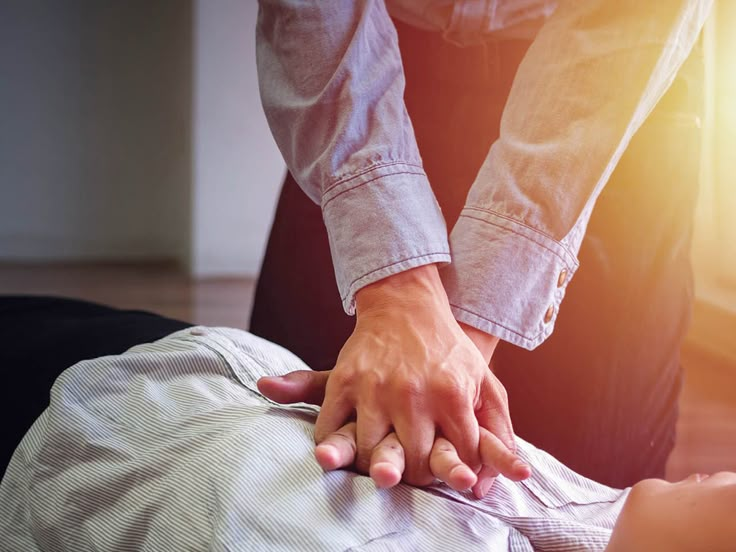
STEP 5: BEGIN CHEST COMPRESSIONS
For an adult who is unresponsive and not breathing normally:
1. Place the person on their back on a firm, flat surface.
2. Kneel beside their chest.
3. Place the heel of one hand in the centre of the chest, on the lower half of the breastbone.
4. Place your other hand on top of the first and interlock your fingers.
5. Keep your arms straight and your shoulders directly above your hands.
6. Push hard and fast, compressing the chest to a depth of about 5–6 cm (2–2.4 inches).
7. Maintain a rate of 100–120 compressions per minute.
8. Allow the chest to return fully to its normal position after every compression.
If you are not trained in CPR or are unable to provide rescue breaths, hands-only CPR is recommended for an adult who suddenly collapses. Keep compressing the chest until help arrives, the person shows signs of life, you are physically unable to continue, or the situation becomes unsafe.
If you are trained and able to give rescue breaths, use the CPR method appropriate to your training. For conventional adult CPR, this is generally 30 compressions followed by 2 breaths.
STEP 6: USE AN AED IF AVAILABLE
An AED is a device that can analyse the heart’s rhythm and deliver an electric shock when necessary.
As soon as the device arrives:
– Switch it on and follow its voice instructions.
– Expose the person’s chest and attach the pads as shown on the device.
– Ensure nobody touches the person while the AED analyses the rhythm or delivers a shock.
– If a shock is advised, follow the instructions and resume CPR immediately when directed.
You do not need to be a healthcare professional to use an AED. The device is designed to guide the rescuer through the process.
STEP 7: CONTINUE UNTIL HELP TAKES OVER
Continue CPR and follow the AED’s instructions until emergency responders take over, the person begins showing signs of life and is breathing normally, you are physically unable to continue, or the scene becomes unsafe.
If the person begins breathing normally but remains unconscious, place them in the recovery position if there is no suspected spinal injury, monitor their breathing continuously, and wait for emergency assistance. If a spinal injury is suspected, avoid unnecessary movement while maintaining their airway and following emergency guidance.
IMPORTANT: WHAT IF THE PERSON IS HAVING A SEIZURE?
If someone collapses and begins convulsing, do not restrain them or put anything in their mouth. Protect them from nearby hazards and cushion their head if possible.
Once the seizure stops, assess their responsiveness and breathing. If they remain unresponsive and are not breathing normally, begin CPR.
WHAT IF THE PERSON HAS FAINTED BUT IS STILL BREATHING?
Not every person who collapses requires CPR.
If the person is breathing normally and is responsive, help them remain safe, assess their condition, and seek medical assistance as appropriate. Do not make them stand up immediately.
If they remain unconscious, do not give them food, water, or medication by mouth. Seek emergency assistance and monitor their breathing.
A heart attack is also different from cardiac arrest. A person experiencing a heart attack may still be conscious and breathing. CPR is not routinely performed on a conscious person who is having a heart attack, but emergency medical assistance is essential.
A FEW THINGS EVERYONE SHOULD KNOW
* CPR is a lifesaving intervention for someone unresponsive and not breathing normally.
* CPR techniques differ for adults, children, and infants. For a child or infant, follow age-appropriate CPR guidance from your training or the emergency dispatcher. Rescue breaths are particularly important in paediatric cardiac arrest.
* An AED can save a life and should be used as soon as it is available.
* Do not waste precious time trying to establish the exact cause of a collapse before acting when cardiac arrest is suspected.
* Emergency services, ambulance access, and AED availability differ around the world. Learn what resources are available in your community before an emergency occurs.
FINAL REMINDER
Imagine someone collapsing in a market, at work, in a school, at home, or on the roadside. People gather around, but everyone assumes someone else knows what to do.
Those few minutes matter.
You do not have to be a doctor or nurse to learn basic lifesaving skills. CPR training can prepare you to respond confidently and appropriately when someone’s life may be at stake.
Learn CPR. Recognise the emergency. Act promptly. You could help save a life.
Umm Sumayyah Mai